
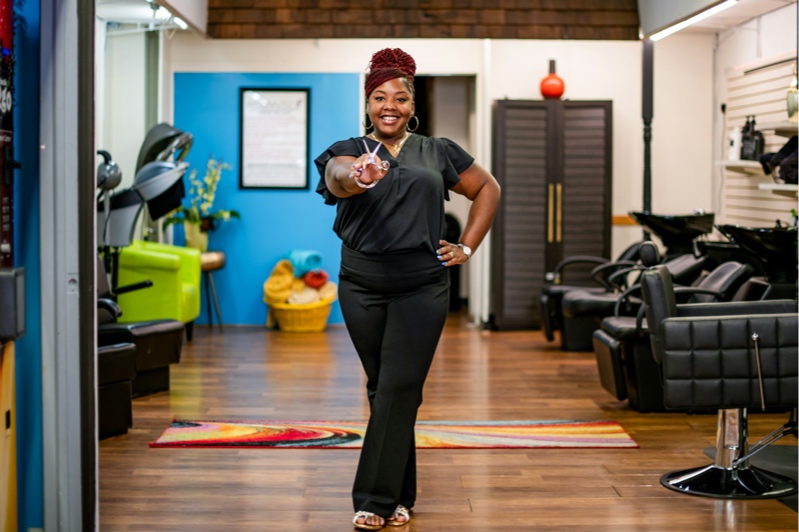
Google "how much do salon owners make" and you'll get a confident answer: $127,973 per year, according to ZipRecruiter. Sounds great. Sounds like a comfortable living.
And it's almost certainly wrong for the majority of independent salon owners in the US.
Search the same question on Indeed, and the number drops to $40,069. Salary.com puts it between $43,261 and $53,306. That's a 3x gap between the highest and lowest estimates for the exact same job title.
The math tells a different story.
Quick Takeaways
- ZipRecruiter's $128K figure mixes chain managers with independent owners — it doesn't reflect most salons
- The average employer salon grosses ~$321K but keeps roughly 8% after expenses (Census/FRED data)
- Booth-rental salon owners average just $12K/year in profit beyond their own chair work
- Commission-based owners with 8+ stylists average $82K — business model matters more than salon type
- Cutting no-shows from 15% to 5% can recover $50K+ in annual revenue for a mid-size salon
How much does a salon owner actually make a year?
Most independent salon owners net $30,000–$75,000 a year. The $128K figure from ZipRecruiter is a salary-aggregator artifact that conflates franchise district managers with solo booth renters, and it doesn't match any primary data source.
It’s hard to pinpoint what the data says because sites like ZipRecruiter scrape job postings.
When a Great Clips franchise group posts a "Salon Owner/Operator" role paying $95K base plus bonus, that gets averaged in alongside every solo stylist who listed "salon owner" on their profile.
Glassdoor reports $103,743, but that's based on just 59 self-reports. People earning $35K don't usually rush to share that number, so the information is already biased.
And here's the part that should make you skeptical of all these sites: ZipRecruiter's own data lists "Nail Salon Owner" at $43,139 on the same platform. Same methodology, same algorithm, and yet one type of salon owner apparently earns 3x what another does? That's not a real finding.
That's bad data aggregation.
The more defensible numbers come from franchise disclosure documents (FDDs), which franchisors are legally required to file. Great Clips single-unit owners net $48K–$82K. Sport Clips: $72K–$92K. Supercuts: $40K–$51K.
These aren't estimates. They're audited.
Where does the money actually go?
A salon that grosses $321,000 (the Census average for employer salons) typically pays out roughly $285,000 in expenses before the owner takes a cent. The industry-wide net profit margin sits around 8%.
The Census Bureau's SUSB data (via FRED) puts average annual revenue for an employer beauty salon at about $321,000. That sounds healthy until you start subtracting.
Payroll and commissions eat the biggest chunk. Industry benchmarks from salon business consultants like Neil Ducoff at Strategies recommend keeping service payroll at 30–35% of revenue.
The industry average actually runs closer to 45–50%.
On $321K, that's $145K gone before anything else.
Rent takes another 6–15% (consultants recommend staying under 10%). Products and back-bar supplies run 5–10%. Then there's insurance, software, credit card processing fees, marketing, and utilities.
By the time you've paid everyone and everything, you're looking at roughly $36K in available owner draw.
That lines up with IBISWorld's reported 8% average profit margin for the hair salon industry.
It also explains why a Salon Today analysis of the top 200 salons in North America found that owner W-2 compensation averaged just 5% of revenue, even at salons doing $1.76 million a year.
Five percent of $1.76M is $88K.
Even at the top, you're nowhere near ZipRecruiter's number.
How much do nail salon owners make compared to hair salon owners?
Nail salon owners typically net $30,000–$50,000; hair salon owners $30,000–$75,000. The gap is smaller than most articles claim because margins are similar across salon types. It's ticket price and volume that differ.
The Bureau of Labor Statistics puts median annual wages for hairdressers and cosmetologists at $35,260, and for manicurists at $34,650. Those are employee wages, so they don't tell you what owners earn.
The closeness still matters, though.
At the worker level, the pay gap between hair and nails is about $600 a year.
Where the numbers diverge is in the average ticket price.
A haircut runs roughly $71 on average; single-process color $106. A basic manicure costs around $25–$35, and a full set of acrylics costs $500–$75. Nail salons compensate with higher throughput (more clients per chair per day), but the per-service margin is thinner.
Medspas are the outlier. The 2024 AmSpa industry report found single-location medspas averaging $1.4 million in revenue with $280K–$500K in owner compensation. Different business entirely, though. Different licensing, equipment, and risk profile.
Why does the business model matter more than salon type?
A booth-rental salon owner and a commission-based salon owner can gross identical revenue and take home wildly different amounts. In a 2025 survey of 70 top-performing owners, booth-rental profit averaged $12K/year while commission-model owners averaged $82K.
That survey comes from Britt Seva at Thriving Stylist, who polled 70 owners in her coaching cohort (the ones actively investing in growth, not the struggling ones). The booth-rental owners averaged $130K in chair-rental revenue and kept about $12K after fixed costs.
The commission-based owners averaged $820K in revenue beyond their own chair and kept $82K.
The distinction matters because most "how much do salon owners make" articles segment by salon type (hair vs. nail vs. beauty) when the more useful lens is business model:
- A solo suite renter (Sola, Phenix) grosses $60K–$95K, but 95% of that is stylist labor income, not ownership profit. They're self-employed with a brand name on the door.
- A booth-rental owner collects rent from stylists but carries the lease, the insurance, the build-out debt. What's left after those fixed costs is often surprisingly thin.
- A commission-based owner with 4–6 stylists typically nets $50K–$90K. Scale that to 8–15 stylists, and you're looking at $90K–$200K. That's where the six-figure salon owners live.
Can you actually make six figures owning a salon?
Six-figure take-home usually requires $500K+ in revenue, a commission or employee model, 8+ service providers, and margins above 15%. Even in the Salon Today 200 (the top-performing salons in North America), owner compensation averaged around $88K.
The Salon Today 200 is the closest thing the industry has to a verified benchmark. Their 2026 honorees averaged $2.375 million in revenue with 32 employees. These are the best-run salons in the country, and even they're paying owners a fraction of revenue.
So what separates a $40K salon from a $100K+ salon? Three operational levers matter more than anything else.
Rebooking rate is the first. The national average sits around 45%. Salons that consistently hit 75%+ have a dramatically more predictable revenue floor, and that gap alone is often the difference between breaking even and being comfortable.
No-shows are the second.
The industry averages 10–20% no-show rates without automated reminders. With SMS and email reminders, that drops below 5%. Do the math on a salon running 500 appointments a month at an $85 average ticket: a 15% no-show rate costs $76,500 a year in lost revenue.
Cut that to 5%, and you've recovered over $50K without booking a single new client.
Utilization is the third. The target is 80–85% of available hours booked. Below 70%, profitability erodes fast regardless of what you charge.
These aren't glamorous factors. They don't show up in the "10 tips to earn more as a salon owner" articles. But they're the ones that compound into the difference between a $40K year and a six-figure one.
The bottom line
Most independent salon owners net $30K–$75K, not $128K. The ones who break into six figures have usually scaled past the solo-operator stage, moved to a commission or employee model, and gotten serious about the operational details that protect margin.
The good news? Those operational levers are the ones you have the most control over. You can't change your city's rent prices. You can't control how many salons open on your block. But you can make sure every client who walks through your door gets rebooked before they leave, and that the ones who've already booked actually show up.
If your scheduling and rebooking process is still manual, that's the first place to start. MyCuts offers automated reminders, online booking, and client management starting at $4.99/month.
It's built for exactly the kind of independent salon owner trying to close the gap between what they gross and what they keep.