Google "salon marketing ideas" and you'll get a listicle of 47 tips written by someone who's never swept a salon floor.
Selfie station. Themed Tuesday. Loyalty punch card.
Cute ideas, all of them, and not one will tell you why your 2 p.m. Thursday slot has been empty for three weeks straight.
The problem isn't that you're not marketing. It's that you're marketing like it's 2019.
Posting quote tiles, boosting random photos, running 20%-off-everything promos that train your clients to wait for the next discount.
Meanwhile, the stylist two chairs over has half your Instagram followers and twice your bookings, because she picked one lane, showed her face, and made it stupid easy to book.
You don't need more ideas. You need fewer ideas done on purpose.
Quick Takeaways
- 86% of Google Business Profile views come from category searches, not your salon name
- SMS appointment reminders get opened roughly 98% of the time and can cut no-shows by up to a third
- Stylists with under 10,000 followers regularly see engagement rates above 7%
- Half of salon bookings happen outside business hours
- A dual-sided referral program outperforms blanket discounts on every metric that matters
Your Google Business Profile Is Your Real Storefront
Before you post a single Reel, win the search you're already losing. About 86% of Google Business Profile views come from category-based searches like "balayage near me," not from people typing your salon name.
Take a moment to consider how you look for a business in your local area, like a car service, restaurant, takeaway, whatever.
You search, Google shows you these kinds of tiles, and you browse through for one that looks good, has a good name, and lots of quality-looking reviews.
This is how people are looking for you, so if your tile (your Google Business listing) isn’t up to scratch, or not showing up at all, you’re missing out.
Not your website. Not your Instagram. Your GBP.
Here are the fundamentals.
Get your categories and services right first.
If your primary category is just "Hair salon," you're invisible to clients searching for "color correction specialist." Birdeye's State of Google Business Profile 2026 report found that category-based discovery drives the vast majority of views.
Be specific about what you do.
Then add photos and keep adding them.
Not your logo. Photos of work on heads in your chair. Localo's analysis of over 2 million profiles found that businesses ranking in the top three positions average more than 250 images; businesses in positions 11–20 average closer to 170. Add new work weekly.
And answer every review.
The same Localo dataset found that top-ranking businesses write responses averaging around 140 words. Every reply is a free micro-post that tells Google you're active and engaged. Thank the five-star reviews with something specific.
Respond to the three-star reviews professionally. Skip none of them. Even a poor experience can turn into a positive one if they see you actively learning and bettering what you have to offer.
Ignoring them typically just makes people feel like you’re hiding from them.
Build a Personal Brand the Algorithm Can't Replace
The stylist who wins on social in 2026 isn't the one with the prettiest feed. It's the one with a face, a name, and a point of view that clients recognize before they walk through the door.
Beauty content is still growing.
Traackr's State of Influence: Beauty 2024 report found hair care video views up 37% year over year. But polished, branded content isn't converting the way it used to.
Sponsored beauty post engagement dropped from 4.5% in 2022 to 2.8% by 2025 as feeds got saturated.
What's working instead is personality. Process. The messy middle of the appointment.
Show the foiling. Show the consultation where the client changed her mind. Show the moment you pivoted the formula.
That's the content people DM about, because it proves you know what you're doing, not just that you can take a good photo of the result.
And you don't need a massive following.
Amra & Elma's 2025 engagement data showed that creators with fewer than 10,000 followers regularly post engagement rates above 7%, compared to roughly 1.4% for accounts over 100,000.
Eight hundred local followers who book appointments will always outperform 20,000 strangers who double-tap (or ignore completely) and scroll on.
Some examples of successful stylists and hair experts doing this well include:
- @hairbychrissy (Chrissy Rasmussen) — Runs Habit Salon in Scottsdale, specializing in blonde transformations and hand-tied extensions. Over 1.5 million followers (8M across platforms) built on behind-the-scenes salon moments and before-and-afters. She's the poster child for "pick one lane" — lived-in blondes and beachy waves is the entire brand.
- @jenatkinhair (Jen Atkin) — Styles the Kardashians, Chrissy Teigen, and Hailey Bieber, but her feed mixes behind-the-scenes work with her garden, personal style, and real-life moments. She proves the "face and a point of view" model at scale.
- @bradmondonyc (Brad Mondo) — Celebrity stylist turned content creator known for energetic transformation videos and humorous reaction clips, with over 13 million followers and his own product line XMONDO Hair. He nailed personality-first content before most stylists even considered showing their face.
Smaller accounts that prove "you don't need a massive following":
- @cervandohair (Cervando Maldonado) — Around 21k followers with a 32.18% engagement rate, which is wildly high. He's exactly the kind of stylist the article describes: modest following, insane engagement, clearly filling chairs.
- @mariaaiellohair (Maria Aiello) — Vidal Sassoon trained, she breaks down techniques for the average person and translates high-end salon skills into tips anyone can try. Her calm, clear instruction style has earned a dedicated following. Good example of "show the process" content.
Niche specialists (the "pick one lane" examples):
- @jayne.edo (Jayne Edo) — All razor cut, done by hand, imperfectly perfect. She's built such a cult following that many women wait a full year to see her, and she now travels the US doing pop-ups and training sessions. The definition of a specialist is getting booked over a generalist.
- @sarahangius (Sarah Angius) — Dutch-Iranian hairstylist with 3.7 million followers, known for elegant, easy-to-follow tutorials focused specifically on braids, buns, and curls. One lane, done consistently.
Pick one lane. Curly hair only. Grey blending without going full silver. Wedding updos that survive Gulf Coast humidity. Specialists get booked. Generalists get scrolled past.
If you're a salon owner managing a team, stop trying to build the salon feed and start coaching each stylist on theirs. Clients follow the chair, not the chandelier.
That's not a problem to fight. It's a hair salon marketing strategy to feed.
SMS Reminders and Online Booking Are Marketing, Not Admin
A scheduling app with text reminders pays for itself the first time it saves one $100 appointment. It's doing more client-acquisition work than your last ten boosted posts combined.
Most beauty salon marketing ideas treat scheduling as operations and Instagram as marketing. In a service business, that's backwards.
Industry data shows SMS open and response rates as high as 98% and 45%, compared to about 20% and 6% for email. When you send an appointment reminder via text, it gets seen.
Consider the math of no-shows.
Bookeo's February 2026 analysis estimates the beauty industry loses around 30% of appointments annually, costing the average salon roughly $67,000 per year. Automated text reminders alone can reduce no-shows by 29–33%.
That's thousands of dollars recovered by a tool that costs less than a pair of shears.
Then there's the booking side.
Roughly half of all salon bookings now happen after business hours. If you're not bookable at 11:47 p.m. when a client finally remembers her roots are showing, you've lost her to whoever is.
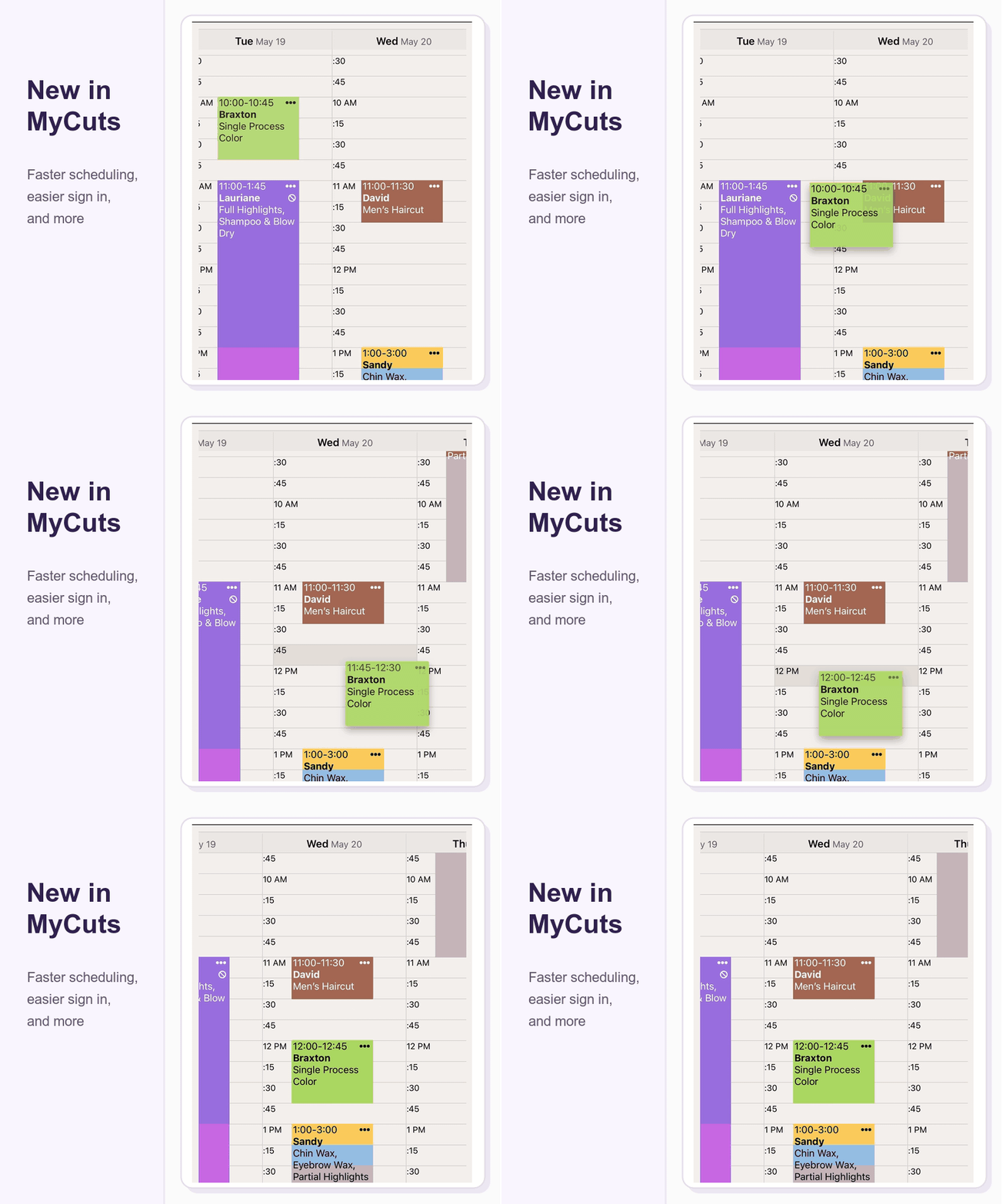
An app like MyCuts fits this slot well for independent stylists and small salons — online booking, automated text and email reminders, client history, inventory tracking, without per-stylist pricing.
For a booth renter, dropping a booking link in your Instagram bio and letting clients schedule at midnight is a salon marketing tool that works while you sleep.
A Referral Program That Pays for Itself
A dual-sided referral incentive (credit for the existing client, a discount for the new one) outperforms every blanket promo you've ever run. And it's cheaper.
A 2013 Wharton study by Schmitt, Skiera, and Van den Bulte found that referred customers showed about 18% lower churn (new customers who came once but didn’t come back) and 16% higher lifetime value than customers acquired through other channels.
That was in banking, not beauty, but the principle holds in any relationship-driven business.
Give the referring client a credit toward her next service. Give the new client a discount on her first visit.
Make it trackable: a unique code, a name field in your booking app, something you can measure. If you're using MyCuts, client notes, and appointment history make it easy to see who's sending you business and follow up with a thank-you text that feels personal.
Run the numbers after 90 days. If at least 15% of new clients are coming through referrals, the program is working. If it's under 5%, the incentive is too small or you're not reminding existing clients it exists.
Drop the Dead Weight
Cutting the wrong salon marketing strategies costs you nothing and buys back hours every week.
Stop buying Groupon traffic. You're paying to acquire the one client who'll never rebook at full price.
Stop boosting random Instagram posts. A $20 boost with no clear offer, no targeted audience, and no booking link is a donation to Meta.
Stop running "20% off everything" promos. Discount your slowest slot or your least-popular service. Never discount your brand.
Stop chasing follower counts. A salon with 800 local followers and a 5% booking conversion rate is running circles around one with 20,000 scattered across three time zones.
The salons winning right now aren't doing more marketing. They're doing fewer things, on purpose, with a face attached. Your Google profile, your booking system, your personal brand. Do those well before you add anything else.